

Introduction
ADHD presents differently in different people — and it looks very different in a seven-year-old boy than it does in a forty-year-old woman. Because the condition is so variable, many people spend years — sometimes decades — not recognising that what they are experiencing has a name and a treatment.
These are the clinical red flags that suggest ADHD may be worth exploring — for adults, for parents of children, and for the people who have always wondered why certain things are just harder for them than for everyone else.
Red flags in adults
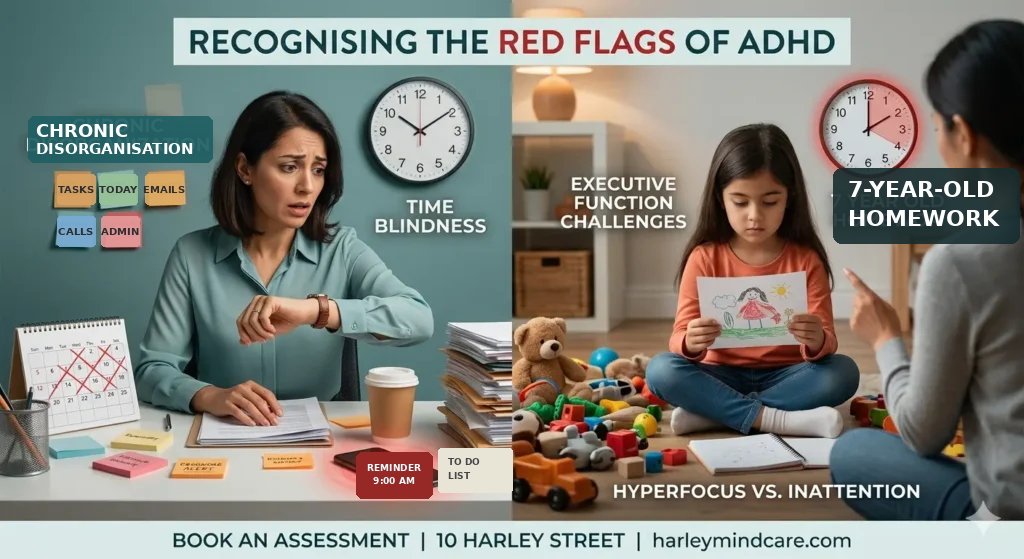
Chronic disorganisation that does not improve despite effort. Not occasional messiness — a persistent inability to maintain structure, meet deadlines, or follow through on tasks that feels beyond normal levels of forgetfulness.
Time blindness. A genuine difficulty perceiving the passage of time — regularly late despite trying not to be, underestimating how long tasks take, losing hours without noticing.
Emotional dysregulation. Intense, rapid emotional reactions that feel disproportionate — particularly rejection sensitivity, where perceived criticism produces a strong emotional response. This is one of the most commonly missed ADHD symptoms in adults.
Difficulty sustaining attention — but also hyperfocus. ADHD is not a simple attention deficit. People with ADHD often find it impossible to concentrate on things they find unstimulating, but can focus intensely for hours on things they find genuinely engaging. Both ends of this spectrum are part of the same condition.
A pattern of underachievement relative to capability. People who are clearly intelligent but whose work, finances, or relationships do not reflect that — often with a history of being told they are not working to their potential.
Sleep difficulties. Many adults with ADHD have persistent difficulty falling asleep — the mind does not switch off easily. This is related to dysregulation of the arousal system.
Impulsivity. Interrupting conversations, making quick decisions without thinking them through, difficulty waiting. In adults this often manifests as financial impulsivity or difficulty in relationships rather than the hyperactive behaviour seen in children.
Red flags in children
Masking at school, struggling at home. Particularly in girls. A child who holds everything together at school and then falls apart at home is not being manipulative — they are exhausted from the effort of appearing neurotypical all day.
Teachers saying your child is bright but not fulfilling their potential. Or that they are disruptive, or that they daydream. These observations, particularly combined with a parent who recognises similar patterns at home, are significant.
Extreme difficulty with transitions. Moving from one activity to another, getting ready to leave the house, starting homework. The meltdown when screen time ends.
Very high energy combined with very poor impulse control. Acting before thinking — physical risk-taking, saying things without considering consequences.
Emotional outbursts that seem disproportionate. A child who cannot regulate their emotional response to frustration, disappointment, or change.
Red flags that are commonly missed
ADHD in women and girls is frequently missed because it tends to be inattentive rather than hyperactive, and because girls are more likely to mask effectively. Key missed signs include anxiety with no clear cause, chronic self-criticism and perfectionism, and organisational difficulties that seem to worsen around hormonal changes — particularly puberty, the postnatal period, and perimenopause.
Late-diagnosed adults often describe a history of anxiety and depression that preceded their ADHD diagnosis. This is because the secondary mental health impact of living with undiagnosed ADHD can be significant — and those secondary symptoms get treated while the underlying cause goes unaddressed.
What to do if you recognise these signs
Recognising these patterns is the first step. The second is getting a proper clinical assessment — not an online checklist, but a structured assessment conducted by a qualified clinician who can consider the full clinical picture, rule out other explanations, and provide a diagnosis that is accepted by GPs, schools, employers, and other services.
Book an assessment at Harley Mind Care
Harley Mind Care is a CQC-registered private psychiatry clinic at 10 Harley Street, London. All assessments are conducted by consultant psychiatrists or paediatricians. No GP referral needed. Virtual appointments available UK-wide.
🌐 harleymindcare.com | 📞 020 7047 8888 | ✉ hello@harleymindcare.com