Introduction
Meltdowns are one of the most commonly misunderstood aspects of autism. Parents describe them as sudden, intense, and often impossible to predict. Teachers sometimes interpret them as behaviour problems. And children themselves are frequently punished or disciplined for something that is not a choice.
Understanding why meltdowns happen — at a neurological and clinical level — changes everything about how parents, schools, and clinicians respond to them.
What is an autistic meltdown?
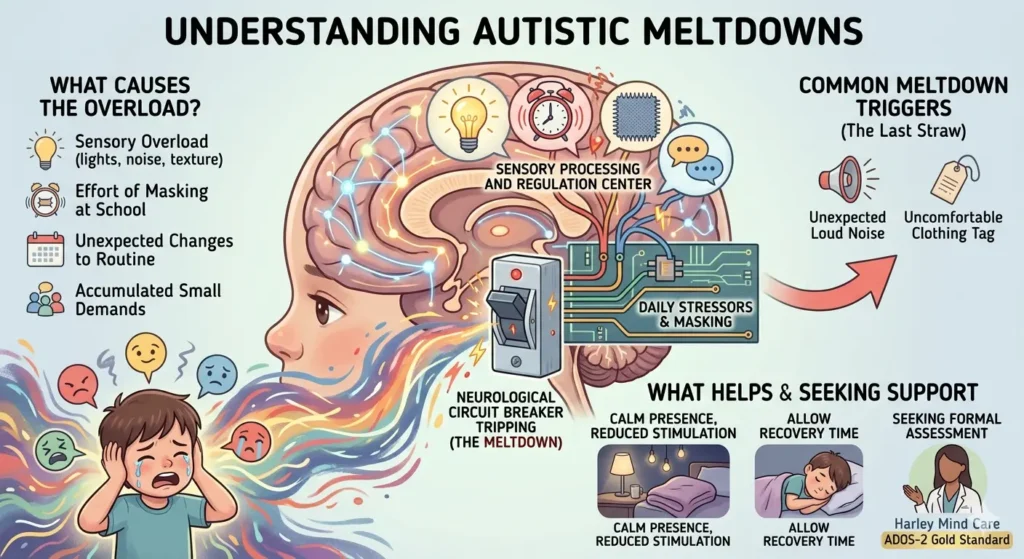
A meltdown is an intense response to overwhelming sensory or emotional input that temporarily exceeds the person’s capacity to regulate. It is not a tantrum, a deliberate behaviour, or a bid for attention. It is a neurological event — the equivalent of a circuit breaker tripping.
During a meltdown a child may cry, scream, hit, self-harm, run, or shut down completely. After a meltdown, many autistic children are exhausted and distressed — they have not “won” anything, and they are often confused and ashamed about what happened. This is a crucial clinical distinction: a meltdown is not behavioural, it is neurological.
Why does it happen?
The autistic nervous system processes sensory information differently. For many autistic people, sensory input — light, sound, texture, smell, social demands — is processed more intensely and with less automatic filtering than in neurotypical people. Over the course of a day, this processing demands more cognitive and emotional resources.
Add to this the effort of masking — the work autistic children do to appear neurotypical at school, following social rules they find confusing and exhausting — and by the end of the school day, many autistic children have depleted their regulatory resources entirely.
The meltdown happens when the accumulated stress exceeds the child’s ability to cope. It is the release of pressure that has been building, often for hours. This is why meltdowns frequently happen at home after school — the child has held everything together all day and then collapses in the one place they feel safe enough to do so.
What triggers a meltdown?
Common triggers include sensory overload — a noisy environment, unexpected touch, bright lights, clothing textures; unexpected changes to routine or plans; transitions between activities; hunger, thirst, or tiredness; social demands and the effort of masking; and accumulated stress from multiple smaller demands throughout the day.
It is important to understand that the trigger that appears to cause the meltdown is often the last straw, not the actual cause. A child who melts down because their sock is uncomfortable is not having a disproportionate response to a sock — they are releasing the accumulated stress of an entire day.
What helps?
Prevention is almost always more effective than response. Understanding your child’s specific sensory and regulatory needs, reducing unnecessary demands in low-energy periods, building in decompression time after school, and preparing for transitions in advance all reduce the frequency and intensity of meltdowns.
When a meltdown is happening, the priority is safety and reduced stimulation — not conversation, explanation, or consequences. The brain is in a state that cannot process language effectively during a meltdown. Quiet, reduced demands, and a calm presence are what help.
After a meltdown, the child needs time to recover before any discussion takes place. Consequences and conversations about behaviour are counterproductive during or immediately after — they add stress at the worst possible moment.
When to seek a formal assessment
Frequent meltdowns, particularly when combined with other signs of autism such as sensory sensitivities, difficulty with social communication, and rigidity around routines, are a clear signal that a formal autism assessment may be helpful. A diagnosis does not change your child — it provides the clinical framework to understand them better, access appropriate support, and advocate effectively for them at school and with local authorities.
At Harley Mind Care, autism assessments for children include the ADOS-2 — the gold standard diagnostic tool — conducted face to face by a psychologist or appropriately skilled clinician, alongside a comprehensive clinical assessment. No GP referral needed.
Book an assessment at Harley Mind Care
Harley Mind Care is a CQC-registered private psychiatry clinic at 10 Harley Street, London. All assessments are conducted by consultant psychiatrists or paediatricians. No GP referral needed. Virtual appointments available UK-wide.
🌐 harleymindcare.com | 📞 020 7047 8888 | ✉ hello@harleymindcare.com