

Introduction
ADHD symptoms are not constant. They fluctuate — sometimes dramatically — depending on circumstances, environment, and the demands being placed on the person. Understanding what makes ADHD worse is practically useful, both for individuals managing their own symptoms and for parents supporting a child with ADHD.
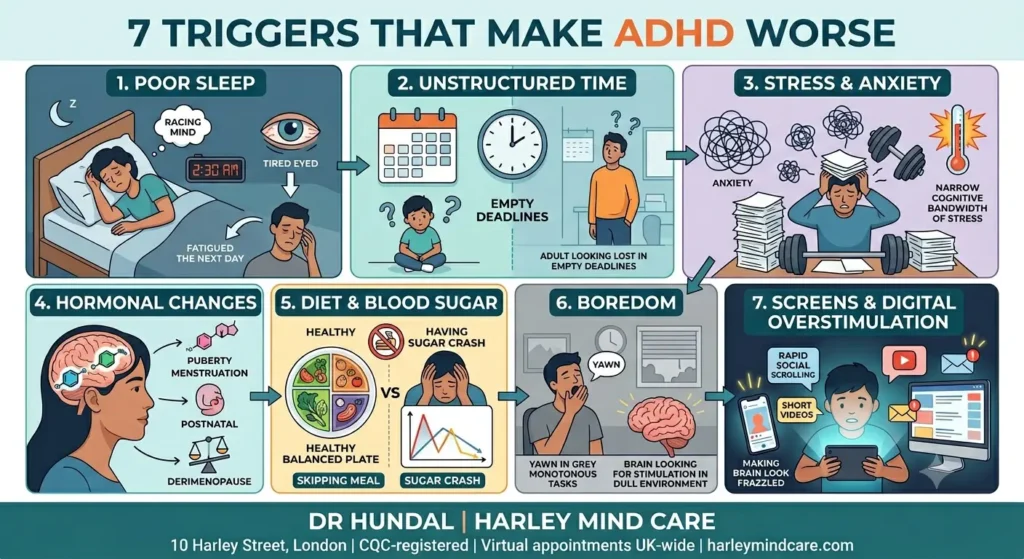
Here are the seven most clinically significant triggers, drawn from current research and our clinical experience at Harley Mind Care.
1. Poor sleep
Sleep and ADHD have a complex, bidirectional relationship. ADHD makes it harder to fall asleep — the brain’s arousal system does not switch off easily, and many people with ADHD experience what is described as a “racing mind” at bedtime. But poor sleep also significantly worsens ADHD symptoms the following day. Attention, impulse control, emotional regulation, and working memory are all degraded by sleep deprivation — and in a person already working harder to manage these functions, the impact is disproportionate.
2. Unstructured time
Counter-intuitively, having nothing to do is harder for many people with ADHD than having too much to do. Without external structure — deadlines, schedules, appointments — the ADHD brain struggles to self-initiate. Unstructured weekends, school holidays, and periods between jobs are common flashpoints. This is one of the reasons ADHD often goes undetected until a major transition, such as starting university or the end of a structured school environment.
3. Stress and anxiety
Stress narrows cognitive bandwidth — and in a person with ADHD, that bandwidth is already constrained. High-stress periods reliably worsen executive function, working memory, and emotional regulation. Anxiety and ADHD frequently co-occur, and each makes the other harder to manage. One of the key clinical challenges is distinguishing whether anxiety is a separate condition, a secondary consequence of living with ADHD, or both.
4. Hormonal changes
ADHD symptoms in women and girls are significantly affected by hormonal fluctuations. Many women report that their ADHD worsens in the week before menstruation, during the postnatal period, and during perimenopause — all periods of significant oestrogen decline. Oestrogen plays a role in dopamine regulation, which is central to ADHD. This explains why women who managed their ADHD reasonably well in their twenties and thirties can find symptoms becoming significantly harder to manage in their forties and beyond.
5. Screens and digital overstimulation
Digital environments are designed to capture and hold attention through constant novelty — which is temporarily very satisfying for the ADHD brain. But prolonged screen time, particularly social media and short-form video, trains the brain to expect very rapid stimulation and makes it harder to sustain attention on slower, more demanding tasks. This is a significant issue for children with ADHD and increasingly for adults. Screen use does not cause ADHD, but it can significantly worsen executive function and attention regulation in people who already have it.
6. Diet and blood sugar instability
The relationship between diet and ADHD is frequently oversimplified in public discussion, but blood sugar regulation is genuinely relevant. Skipping meals, eating high-sugar foods, and the subsequent blood sugar crash reliably worsen concentration and impulse control. Many people with ADHD also have difficulty with hunger awareness — they become absorbed in what they are doing and forget to eat — which then leads to the very blood sugar instability that worsens their symptoms. Regular meals with a reasonable protein content help maintain the metabolic stability that supports cognitive function.
7. Boredom
Boredom is not just unpleasant for people with ADHD — it is neurologically aversive. The ADHD brain requires a certain level of stimulation to function optimally, and in the absence of that stimulation it seeks it elsewhere. This is the neurological basis of many behaviours that look like disruptiveness, inattention, or impulsivity — they are the brain attempting to regulate itself. Repetitive tasks, long meetings, subjects that hold no interest, and waiting are all particularly difficult.
What this means in practice
Understanding your personal trigger pattern — or your child’s — is one of the most practical aspects of managing ADHD well. It allows you to anticipate difficult periods, put structures in place, and make adjustments that reduce the impact. This kind of practical knowledge is one of the things a good ADHD assessment and post-diagnosis support should provide.
Book an assessment at Harley Mind Care
Harley Mind Care is a CQC-registered private psychiatry clinic at 10 Harley Street, London. All assessments are conducted by consultant psychiatrists or paediatricians. No GP referral needed. Virtual appointments available UK-wide.
🌐 harleymindcare.com | 📞 020 7047 8888 | ✉ hello@harleymindcare.com