Introduction
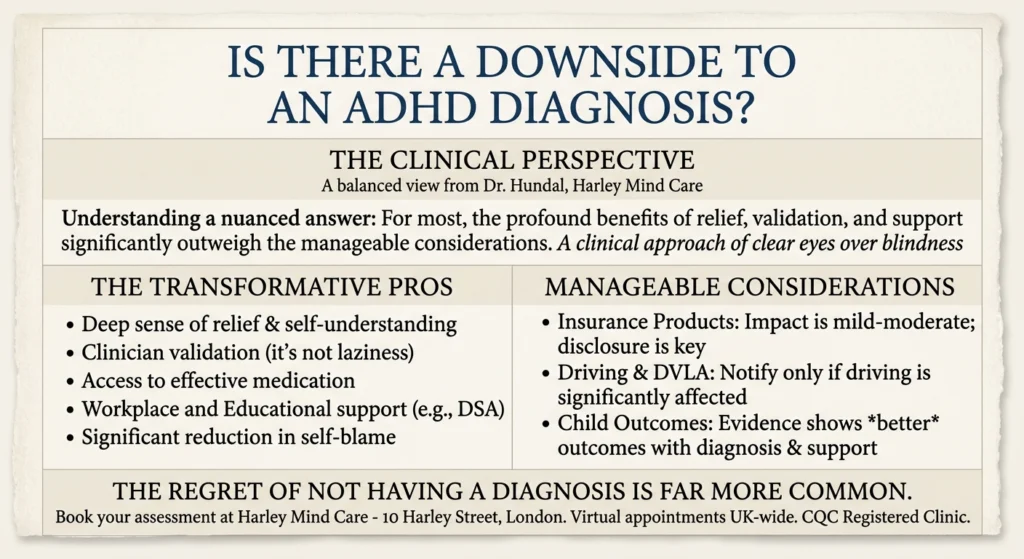
Honest clinical practice means acknowledging when a question has a nuanced answer. So when people ask whether there is a downside to getting an ADHD diagnosis — yes, there are things worth knowing. For most people, the benefits significantly outweigh the disadvantages. But going in with clear eyes is always better than going in blind.
The honest pros
For most people who receive an ADHD diagnosis, the primary experience is relief. Understanding why certain things have always been harder — and having that understanding validated by a clinician rather than dismissed as laziness or lack of effort — is genuinely significant. Access to medication that works for approximately 75-80% of people with ADHD can be life-changing. Workplace adjustments, educational support, and DSA for students all become available. And the reduction in self-blame that comes with diagnosis is something patients describe repeatedly as transformative.
What about insurance?
Some people are concerned that an ADHD diagnosis will affect their insurance products. This is worth understanding properly rather than fearing. Life insurance and income protection policies typically ask about mental health diagnoses at the point of application or renewal. ADHD is a neurodevelopmental condition, not a mental illness — though the distinction is not always reflected consistently across insurance products. The impact varies considerably by provider, policy, and the nature of your ADHD. Mild to moderate ADHD that is well managed typically has minimal impact on most insurance products. More significant presentations may result in slightly adjusted premiums or exclusions on some policies. The key is to be honest on applications — non-disclosure is more problematic than disclosure.
What about driving and the DVLA?
You are required to inform the DVLA if your ADHD significantly affects your ability to drive safely. For most people with well-managed ADHD, this does not result in licence restrictions. The DVLA will conduct a medical review and may request information from your clinician. ADHD medication does not automatically disqualify you from driving, but certain medications require notification. We can guide you through this process at Harley Mind Care.
What about the impact on children?
Some parents worry that a diagnosis will define their child or become a self-fulfilling prophecy. This concern is understandable but not supported by evidence. Research consistently shows that children who receive appropriate diagnosis and support have better outcomes — educationally, socially, and in terms of mental health — than those who go undiagnosed. A diagnosis gives a child access to support they would not otherwise receive. It does not limit them.
What about the current media climate?
There is currently significant media coverage questioning the reliability of ADHD diagnoses — particularly from online and app-based providers. This coverage has merit in part: some providers are not conducting thorough assessments. But it should not deter people from seeking a proper assessment from a reputable, CQC-registered, consultant-led clinic. The question to ask is not whether to get an assessment — it is where to get one.
Our clinical view
In over a decade of clinical practice, the patients who express regret about receiving an ADHD diagnosis are extremely rare. Far more common are the patients who wish they had sought assessment earlier — who spent years in unnecessary difficulty before understanding what was happening and accessing support that helped. The downside of an ADHD diagnosis, for most people, is far smaller than the downside of not having one.
Book an assessment at Harley Mind Care
Harley Mind Care is a CQC-registered private psychiatry clinic at 10 Harley Street, London. All assessments are conducted by consultant psychiatrists or paediatricians. No GP referral needed. Virtual appointments available UK-wide.